

B.R.A.I.N.: A Simple Framework for Informed Consent During Pregnancy and Birth
/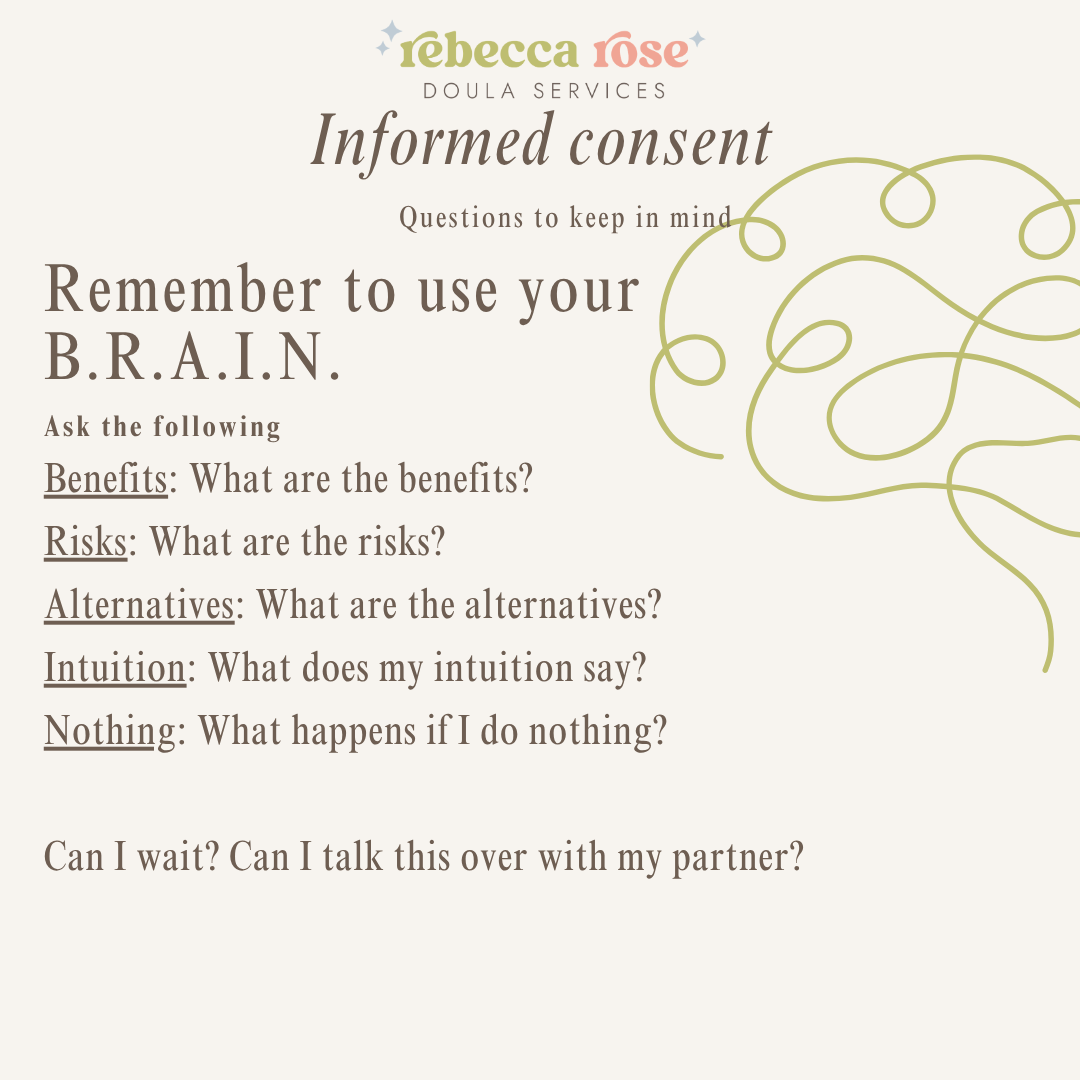
Educational infographic from Rebecca Rose Doula Services explaining the B.R.A.I.N. decision-making framework for informed consent in pregnancy, labor, birth, and postpartum. Families can use B.R.A.I.N. (Benefits, Risks, Alternatives, Intuition, and Nothing) to ask thoughtful questions, understand their options, and make evidence-based decisions alongside their healthcare provider.
B.R.A.I.N.: How to Make Confident, Informed Decisions During Pregnancy and Birth
One of the most important jobs of a doula isn't making decisions for you it's helping you feel informed enough to make your own.
Throughout pregnancy, labor, birth, and postpartum, you may be offered dozens of tests, medications, procedures, and interventions. Some may be medically necessary. Others may simply be routine. Some are supported by strong evidence, while others are performed because "that's just how we've always done it."
Knowing the difference is empowering.
That's where B.R.A.I.N. comes in.
📥 Download Your Free B.R.A.I.N. Decision-Making Card
What Is Informed Consent?
Informed consent is the process of receiving enough information to make a voluntary decision about your own healthcare.
True informed consent means your provider explains:
Why something is being recommended
The potential benefits
The possible risks
Alternative options
What happens if you decline or wait
Answers your questions
Gives you time to decide whenever safely possible
Your provider brings medical expertise.
You bring your values, preferences, goals, and lived experience.
Together, those create the best decision for your family.
Hospital Policy vs. Evidence-Based Care
One thing many families don't realize is that hospital policy is not the same thing as evidence-based medicine.
Hospital policies are often created for reasons such as:
Staffing
Scheduling
Liability
Standardization
Resource availability
Administrative efficiency
These policies may be reasonable but they aren't automatically supported by the highest-quality research.
Evidence-based care combines three things:
The best available research
Your provider's clinical expertise
Your own goals and values
Sometimes these align perfectly.
Sometimes they don't.
For example:
A hospital may routinely induce labor at 41 weeks.
Another hospital may recommend waiting until 42 weeks with increased monitoring.
Both may be following their own policy.
The evidence is more nuanced and depends on factors like maternal health, baby's well-being, amniotic fluid levels, fetal monitoring, previous pregnancies, and your personal risk factors.
When someone says,
"This is hospital policy."
It's okay to respectfully ask,
"Can you also explain the evidence behind this recommendation for my specific situation?"
That's not being difficult.
That's participating in your own healthcare.
What Does B.R.A.I.N. Stand For?
Whenever you're faced with a decision, ask these five questions.
B - Benefits
Ask:
What are the benefits?
Questions to consider:
How could this help me?
How could it help my baby?
Is this likely to improve our outcome?
Is it preventive or treating a problem?
Example
Your provider recommends continuous fetal monitoring.
You might ask:
How does continuous monitoring benefit my baby?
Does it reduce certain risks?
Is intermittent monitoring appropriate for my situation?
R - Risks
Ask:
What are the risks?
Every intervention even doing nothing potential risks.
Questions might include:
What are the side effects?
What complications could happen?
How common are those complications?
How serious are they?
Example
Your provider recommends Pitocin.
You could ask:
Does Pitocin increase contraction intensity?
Could it affect my pain management choices?
Are there any risks for me or my baby?
A - Alternatives
Ask:
What are my alternatives?
Healthcare is rarely "one option only."
Sometimes there are several safe approaches.
Examples include:
Waiting
Trying another medication
Position changes
Hydration
Additional monitoring
Different induction methods
Returning later
Example
Instead of immediate induction after your water breaks, your provider may discuss:
Expectant management
Additional monitoring
Going home (if appropriate)
Antibiotics if indicated
Not every option is appropriate for every pregnancy—but it's okay to ask what alternatives exist.
I - Intuition
Ask yourself:
What is my intuition telling me?
This doesn't replace medical advice.
It simply reminds you that your thoughts, emotions, beliefs, and comfort matter too.
Ask yourself:
Do I feel rushed?
Do I understand this recommendation?
Does this align with my birth goals?
Do I need more information?
Am I making this decision because I want to or because I feel pressured?
Sometimes your intuition says,
"Yes, this feels right."
Other times it says,
"Can I have a few minutes to think?"
Both are valid.
N - Nothing
Ask:
What happens if we do nothing for now?
This may be one of the most powerful questions.
Sometimes the answer is:
"Nothing changes."
Sometimes it's:
"The risk increases significantly."
Sometimes it's:
"Let's reassess in two hours."
Knowing what happens if you wait helps you understand whether the decision is urgent or simply time-sensitive.
Real-Life Example: A Cervical Exam
Your provider asks if you'd like a cervical exam at 39 weeks.
Instead of automatically saying yes or no, you could think through B.R.A.I.N.:
Benefits
What information will this give us?
Will it change today's plan?
Risks
Could it be uncomfortable?
Is there a small risk of bleeding or infection?
Alternatives
Can we skip it today?
Could we wait until labor begins?
Intuition
Do I actually want this exam?
Nothing
What happens if we don't check today?
Suddenly, the decision becomes much clearer.
Real-Life Example: Elective Induction
Your provider recommends induction at 39 weeks.
You might ask:
Benefits
Why are you recommending induction for me specifically?
Risks
Does induction increase my chance of needing additional interventions?
Alternatives
Could we wait a few more days with monitoring?
Intuition
What feels right for my family?
Nothing
If baby and I are healthy, what happens if we wait until my next appointment?
Can I Ask for More Time?
In many situations, yes.
Some helpful phrases include:
"Can you explain why you're recommending this?"
"Is this urgent, or do we have some time to think?"
"Can you explain the evidence behind this recommendation?"
"Can I discuss this with my partner?"
"Can we revisit this in an hour?"
"Are there other reasonable options?"
If your provider says the situation is an emergency, there may not be time for a lengthy discussion.
But many decisions in pregnancy and labor are not true emergencies.
There is often time to ask questions.
Remember: B.R.A.I.N. Is a Conversation Tool, Not a Checklist
The goal isn't to challenge your provider or delay necessary care.
The goal is to foster open communication so you understand your options and feel confident in the decisions you make.
Good providers welcome thoughtful questions and want you to feel informed.
How Your Doula Can Help
While doulas do not give medical advice or make medical decisions, they can help you:
Slow down and process information
Remember the B.R.A.I.N. questions
Clarify what you've heard
Encourage communication with your provider
Support your preferences
Help you feel calm and confident during decision-making
Our role is to help you feel informed not influence your choices.
Final Thoughts
Every birth is unique, and there is rarely one "right" answer for everyone.
The best decisions are made when you understand your options, your provider understands your goals, and both work together using the best available evidence.
Whether you're deciding about an induction, epidural, cervical exam, continuous monitoring, cesarean birth, or any other aspect of your care, remember:
Benefits. Risks. Alternatives. Intuition. Nothing.
Take a breath, ask questions, and know that your voice matters.
At Rebecca Rose Doula Services, we believe informed families make empowered decisions not because someone told them what to choose, but because they understood their options and felt supported every step of the way.