

My Water Broke… Now What | Rebecca Gensch, Certified Birth Doula
/
Learn what to do after your water breaks, when to call your provider, what to watch for, and how to make informed decisions about your next steps. This article is for educational purposes only and is not medical advice.
Rebecca Gensch, Certified Birth Doula
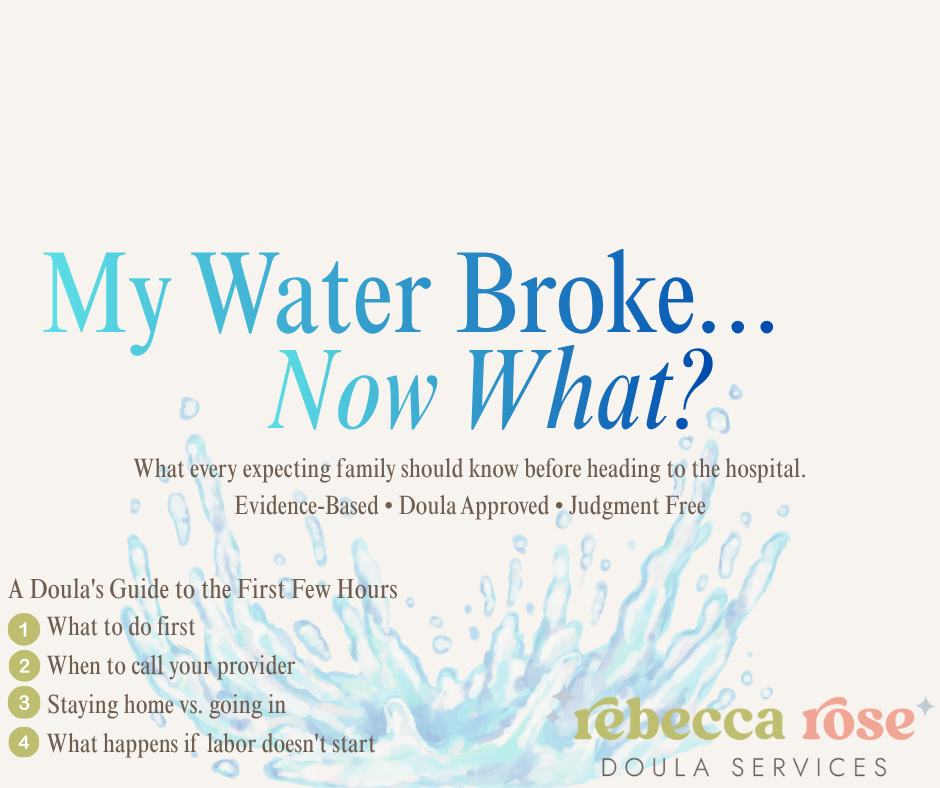
My Water Broke… Now What?
One of the biggest questions we get as doulas is:
"My water just broke... what do I do now?"
For many families, especially first-time parents, there is still plenty of time before baby arrives. Movies make it seem like your water breaks, contractions immediately become intense, and everyone rushes to the hospital.
Real life usually looks very different.
For most families, your water breaking is simply the beginning of a brand-new chapter. Whether labor starts in an hour or a day later, knowing what to expect can help you feel calmer, more confident, and prepared for what's ahead.
Let's walk through it together.
What Does It Mean When Your Water Breaks?
During pregnancy, your baby is surrounded by the amniotic sac, a thin membrane filled with amniotic fluid that cushions, protects, and supports your baby's development.
When this sac opens, it's called rupture of membranes (ROM) or what most people know as your water breaking.
This can happen:
Before labor starts (called premature rupture of membranes, or PROM)
During active labor
While you're pushing
Or your provider may recommend artificially breaking your water during labor (AROM)
Only about 8-10% of pregnancies begin with the water breaking before contractions start. Most people actually begin labor first, and their membranes rupture later as labor progresses.
How Can You Tell If It's Really Your Water?
Sometimes it's obvious.
Sometimes... not so much.
Amniotic fluid may look like:
A dramatic gush
A slow trickle
Constant leaking
Small spurts every time you stand up
Wet underwear that keeps coming back
Amniotic fluid is usually:
Clear
Pale yellow
Mostly odorless or slightly sweet
Unlike urine, you usually can't stop the leaking by tightening your pelvic floor muscles.
Sometimes what feels like your water breaking is actually:
Urine (very common in pregnancy!)
Increased vaginal discharge
Semen after intercourse
Sweat
If you're unsure, your healthcare provider can perform a simple evaluation to determine whether your membranes have ruptured.
Should I Call My Provider Right Away?
Yes.
Even if contractions haven't started, let your provider or midwife know that you think your water has broken.
They'll likely ask:
What time did it happen?
What color was the fluid?
Was it a gush or a trickle?
Is your baby moving?
Are you having contractions?
Do you have a fever?
Have you tested positive for Group B Strep (GBS)?
How many weeks pregnant are you?
These answers help determine the safest next steps for you and your baby.
What Color Should Amniotic Fluid Be?
Clear or Pale Yellow
This is the most common and is generally reassuring.
Pink Tinged
A small amount of blood can be completely normal, especially after a cervical exam or membrane sweep.
Green or Brown
This may indicate meconium, meaning your baby passed stool before birth. Contact your provider promptly, as they'll likely want to evaluate you and your baby sooner.
Bright Red Bleeding
Heavy bleeding is not normal and should be evaluated immediately.
Do I Need to Go to the Hospital Immediately?
Not always.
The answer depends on several factors, including:
How far along you are
Your Group B Strep (GBS) status
Your baby's movement
The color of your amniotic fluid
Whether contractions have started
Your medical history
Your healthcare provider's recommendations
For many healthy, low-risk pregnancies at term, there may be time to stay home while labor begins naturally. Every situation is different, which is why it's so important to communicate with your healthcare team.
Can I Shower, Eat, or Sleep?
One of the first questions families ask is,
"Okay... now what? Do I just sit here and wait?"
The answer is not necessarily.
If your healthcare provider has confirmed it's safe for you to remain at home, this is often a beautiful opportunity to slow down and let your body do what it was designed to do.
You may choose to:
🍽️ Eat a nourishing meal.
💧 Drink plenty of water or electrolytes.
🚿 Take a warm shower.
😴 Rest or even take a nap.
🚶♀️ Go for a gentle walk.
👜 Finish packing your hospital bag.
❤️ Spend quiet time with your partner.
⏱️ Begin timing contractions if they start.
Here's something many people don't realize: every provider manages ruptured membranes a little differently.
Some providers may ask you to come directly to Labor & Delivery after your water breaks. Others may recommend coming in for a quick evaluation to confirm your membranes have ruptured, check your baby's heart rate with a non-stress test (NST), and make sure everything looks reassuring. If both you and your baby are doing well, some providers may then recommend returning home to continue waiting for labor to begin naturally, sometimes with repeat monitoring every 12-24 hours until active labor starts. Every practice has its own protocols, which is why it's so important to have a conversation with your healthcare team.
This is a wonderful time to use the B.R.A.I.N. decision-making tool.
Ask questions like:
What are the benefits of coming in now?
What are the risks of waiting a little longer?
If everything looks reassuring, is it reasonable to return home?
What would make you want me to come back sooner?
Remember, once your water breaks, we want labor to start but it doesn't have to happen immediately.
Your body is incredibly smart. The amniotic fluid contains hormones and chemical messengers that help signal your body that it's time for labor. Those signals take time to create the beautiful hormonal cascade that leads to contractions. Labor isn't a switch that's flipped it's a process.
As doulas, we often remind families that oxytocin is the hormone that helps labor unfold, and oxytocin thrives in environments where we feel safe, loved, and relaxed. For many people, that's home not a bright hospital room with unfamiliar sounds and interruptions.
If your provider feels it's medically safe, this can be a wonderful time to curl up on the couch, watch your favorite comfort show, laugh with your partner, eat a good meal, bounce on the birth ball, listen to music, take a shower, or even get some sleep. Conserving your energy now can make a huge difference once active labor begins.
That doesn't mean staying home is always the right answer. If you're GBS positive, have signs of infection, notice green or brown amniotic fluid, experience decreased fetal movement, are preterm, or your provider has other concerns, they may recommend coming to the hospital sooner and those recommendations are there to keep you and your baby safe.
The goal isn't to stay home as long as possible.
The goal is to make an informed decision based on your pregnancy, your baby, and the best available evidence.
Once your membranes have ruptured, avoid putting anything into the vagina unless your healthcare provider specifically recommends it. This includes tampons, intercourse, or anything else that could increase the risk of introducing bacteria into the uterus.
What If Labor Doesn't Start?
One of the biggest misconceptions about labor is that contractions should begin immediately after your water breaks. While that certainly happens for some families, it's completely normal if labor doesn't start right away.
In fact, when your water breaks, your body is just beginning another important step in the labor process.
Your amniotic fluid doesn't just cushion and protect your baby during pregnancy it also contains hormones, proteins, and chemical messengers that help prepare your body for labor. After your membranes rupture, these natural signals continue working with your body to stimulate the release of labor hormones like prostaglandins and oxytocin, which help soften the cervix and encourage contractions. This process isn't instantaneous. Just like every pregnancy is unique, every labor unfolds on its own timeline.
According to Evidence Based Birth®, it is common for labor to begin naturally within 72 hours after your water breaks at term (term premature rupture of membranes, or PROM). Many people will begin labor much sooner, while others may take a day or two. Both can be completely normal depending on your individual circumstances.
Rather than focusing on the clock alone, your healthcare provider will consider several important factors when deciding what the safest next steps are, including:
How many weeks pregnant you are
Whether you tested positive for Group B Streptococcus (GBS)
Your baby's heart rate and movement
The color of your amniotic fluid
Whether you have any signs of infection, such as a fever or uterine tenderness
Your overall health and pregnancy history
If labor hasn't started, your provider may discuss one of two approaches.
Expectant Management
Expectant management means allowing more time for labor to begin naturally while continuing to monitor both you and your baby. If everything remains reassuring, this may include monitoring your temperature, paying attention to your baby's movements, and checking in with your healthcare team as recommended.
Induction of Labor
In some situations, induction may be recommended instead of continuing to wait. This recommendation may be based on factors such as being GBS positive, developing signs of infection, concerns about your baby's well-being, or other medical conditions that make continuing the pregnancy less safe than beginning labor.
There isn't one "right" answer for everyone. The best decision is one that's made using the best available evidence, your medical history, your preferences, and a thoughtful conversation with your healthcare provider.
If induction is recommended, consider using the B.R.A.I.N. decision-making tool:
Remember, your water breaking is just one part of the incredible hormonal dance that leads to labor. Whether contractions begin in an hour or over the next day or two, your body is often continuing to prepare for birth behind the scenes.
What Is GBS and Why Does It Matter?
If you've tested positive for Group B Streptococcus (GBS), your provider will typically recommend antibiotics during labor to help reduce the risk of passing the bacteria to your baby.
If your water breaks before labor begins, your GBS status may influence how long your provider recommends waiting before coming to the hospital or beginning induction. This is one of the many reasons it's important to call your provider when your water breaks so you can make a plan together.
When Should I Seek Immediate Medical Care?
Contact your provider or seek immediate medical evaluation if you experience:
Heavy vaginal bleeding
Green or brown amniotic fluid
Fever or chills
Decreased fetal movement
A prolapsed umbilical cord (seeing or feeling the cord)
Severe abdominal pain
Signs of labor before 37 weeks
Any symptoms your healthcare provider has instructed you to report
If you're ever unsure, it's always okay to call your provider or your Labor & Delivery unit. That's what they're there for.
How Can a Doula Help If Your Water Breaks?
One of the greatest gifts of having a doula is that you don't have to navigate these first few hours alone.
While we can't diagnose or make medical decisions, we can help you feel calm, informed, and supported while you communicate with your healthcare team.
Your doula can help you:
Talk through what's happening.
Review your birth preferences.
Encourage rest, hydration, and nourishment.
Suggest comfort measures while labor gets started.
Help you understand your options.
Join you once active labor begins.
Many families tell us these early hours are some of the most emotional and having someone to text or call can make all the difference.
Questions to Ask Your Provider
If your water has broken and labor hasn't started yet, consider asking:
Is my baby doing well?
Are there any signs of infection?
What are the benefits and risks of waiting?
What are the benefits and risks of induction in my situation?
Is it reasonable to go home if everything looks reassuring?
How does my GBS status change the recommendation?
What symptoms should make me come back immediately?
When would you like me to check in again?
The Bottom Line
For many families, your water breaking is the beginning of an exciting new chapter not necessarily an emergency.
Every pregnancy is different. Every labor unfolds differently. There is no "perfect" timeline for labor to begin.
The most important thing is staying connected with your healthcare provider, understanding your options, and making decisions that fit your pregnancy and your baby.
At Rebecca Rose Doula Services, we believe informed families make empowered decisions. Whether your contractions begin an hour after your water breaks or your body takes a little longer to get there, know that you're not alone.
We're cheering you on every step of the way.
Sources, References & Medical Disclaimer
At Rebecca Rose Doula Services, we believe every family deserves access to evidence-based education so they can feel informed, empowered, and confident throughout pregnancy, birth, and postpartum.
The information shared in this article is for educational purposes only and is not intended to replace medical advice, diagnosis, or treatment. We are birth and postpartum doulas not physicians, certified nurse-midwives, nurses, or other licensed medical providers. While we stay current on the latest research and are passionate about evidence-based care, we do not diagnose medical conditions, interpret medical tests, prescribe treatments, or make medical decisions for our clients.
Every pregnancy is unique. Recommendations after your water breaks depend on many factors, including your gestational age, Group B Streptococcus (GBS) status, your baby's well-being, the color of your amniotic fluid, signs of infection, your medical history, and your healthcare provider's clinical judgment.
If you believe your water has broken or you have concerns about your pregnancy, always contact your OB-GYN, midwife, or Labor & Delivery unit. Together with your healthcare team, you can discuss your options, ask questions, and determine the safest plan for you and your baby.
Our goal is to provide compassionate, evidence-based education and emotional support not medical advice. We encourage every family to ask questions, understand the available evidence, and use tools like B.R.A.I.N. (Benefits, Risks, Alternatives, Intuition, and Nothing) to partner with their healthcare provider in making informed decisions.
Sources & References
The information in this article was informed by current research and recommendations from the following trusted organizations:
Evidence Based Birth®
Evidence on Inducing Labor for Term Prelabor Rupture of Membranes (PROM)
Evidence on the Hormonal Physiology of Labor and Birth
Evidence on Group B Streptococcus (GBS)
Website: https://evidencebasedbirth.com
American College of Obstetricians and Gynecologists (ACOG)
Practice Bulletin No. 217: Prelabor Rupture of Membranes
Patient FAQ: Prelabor Rupture of Membranes
Guidance on Group B Streptococcus in Pregnancy
Website: https://www.acog.org
Society for Maternal-Fetal Medicine (SMFM)
Clinical guidance regarding prelabor rupture of membranes and high-risk pregnancy management.
Website: https://www.smfm.org
American Academy of Pediatrics (AAP)
Guidance on newborn care and prevention of early-onset Group B Streptococcal disease.
Website: https://www.aap.org
World Health Organization (WHO)
WHO Recommendations: Intrapartum Care for a Positive Childbirth Experience.
Website: https://www.who.int
Last reviewed: July 2026
Because birth research continues to evolve, we encourage families to discuss any questions about new research, changing recommendations, or their personal medical circumstances with their healthcare provider.